 Joel Stevick
Chapter 9 · section 5 of 8
As of
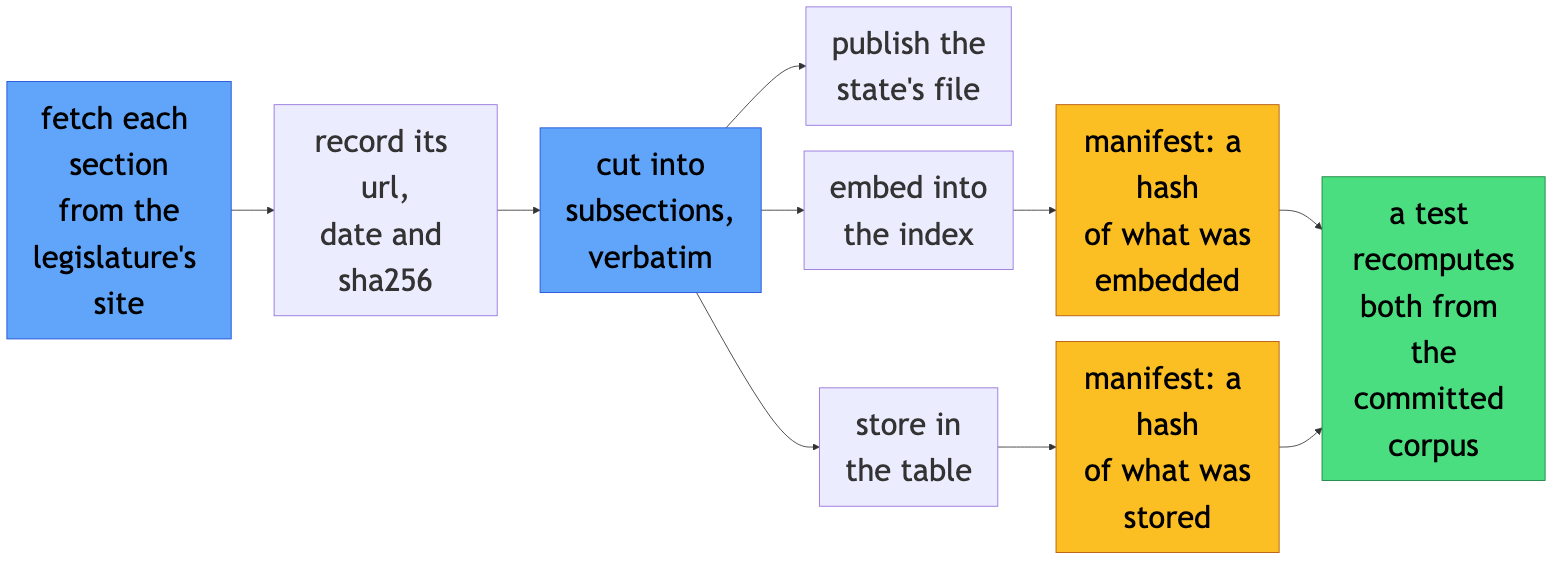
Every law carries the day its source was fetched, and the box shows it under the answer: as of 5 Oct 2026. An as-of date is the date a fact was true as of, which is to say the date the source was read, not the date the law was enacted. A law can be older; a later edition can change it. For a code chunk the date is the section file’s retrieved field in SOURCES.json. For a manual law it is the retrieved date of the state’s manual PDF, in the manuals’ own SOURCES.json.
The comment on the deployed function that dates every law records one rule that is worth carrying: a law whose date cannot be found fails the build, naming the file, rather than going out undated or dated today. A new state whose manual was never recorded is a build error, not a citation that tells a reader its manual is as of the deploy.
Once a month a person runs a refresh: every fetched section is fetched again and compared with its committed copy, and a dated report lists the ones that changed, with a diff. The committed sources are not touched. Applying a change is a person’s job, through the same route that fetched the section the first time, and a source that cannot be fetched is recorded as unreachable, never as unchanged.