 Joel Stevick
Introduction · section 1 of 8
Introduction
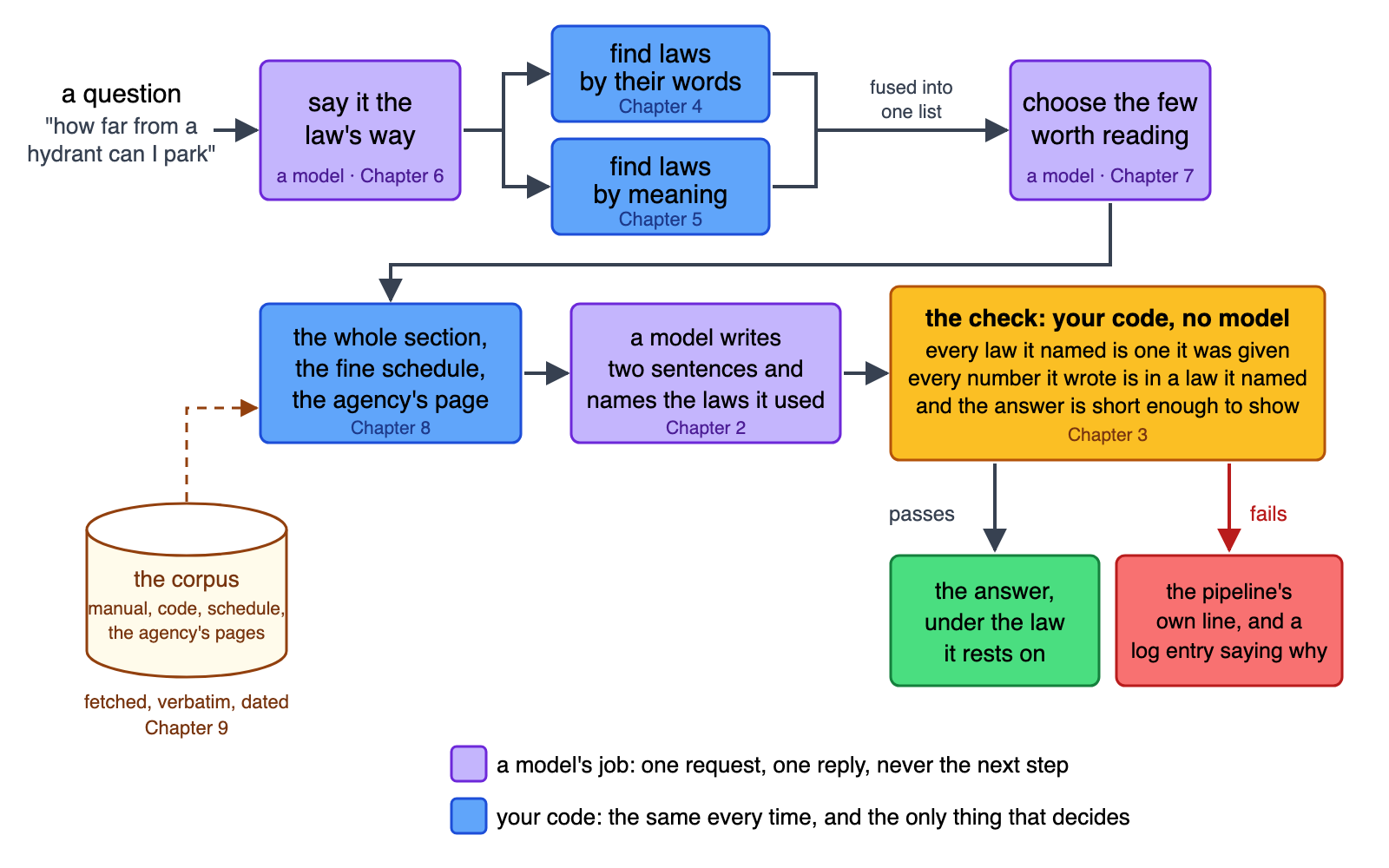
A workflow is a fixed sequence of jobs that a piece of work passes through, where each job has one responsibility and a defined output.
An agentic workflow is one in which some of those jobs are carried out by a language model rather than by a person or by code you wrote in advance.
The picture above is one. A question goes in at the left and an answer comes out at the right, and of the eight jobs between them, three are done by a model: one restates the question in the words the law uses, one picks the few laws worth reading from a longer list, and one writes the answer. The other five are ordinary code you will type, and the one at the end is the reason the whole thing can be trusted: it decides, without asking any model, whether the answer may be shown.
What it is not
An agent is a program that calls a model in a loop, runs whatever tool the model asks for, and stops when the model stops asking. The model picks the next step. This book does not build one, and the pipeline it builds has no loop of that kind anywhere in it.
That is a design choice, and it is worth stating at the start because the word agentic on the cover will make some readers expect the other thing. In this pipeline your code picks every next step, and each model call is one request and one reply. The model never decides whether to search again, never decides which law to look up, and never decides whether its own answer is good enough. Where a job needs judgement about language, a model does it; where a job needs to be the same every time, code does it; and the job of deciding what reaches the screen is always the second kind.